

By Haidar Sohaili Esfahani
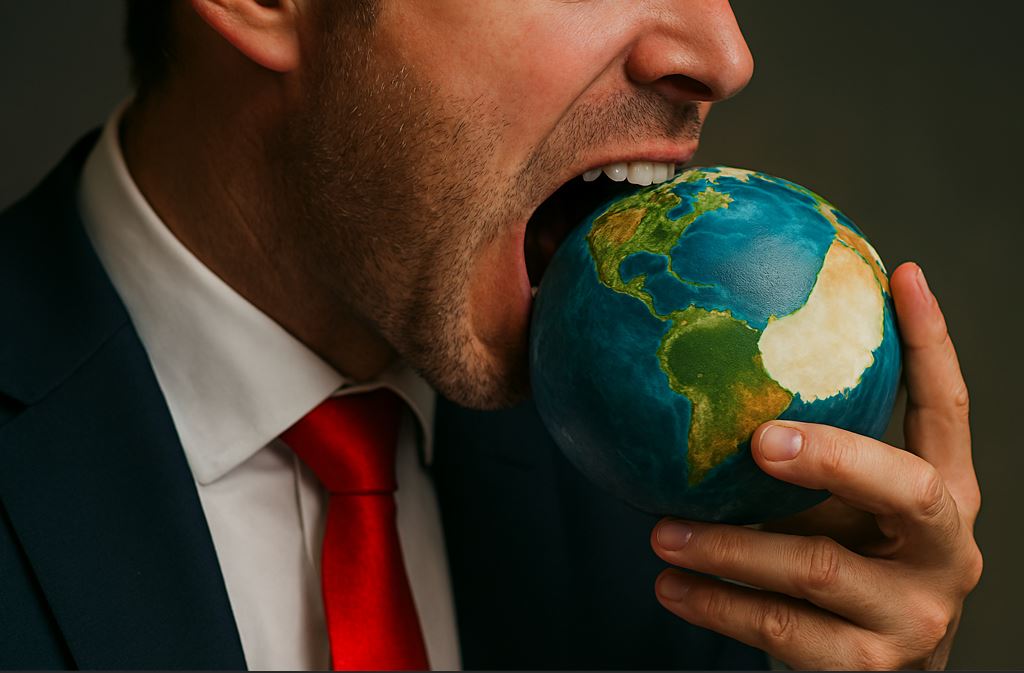
While the President of the United States stands at the United Nations podium mocking the climate crisis, major polluting corporations dance to the rhythm of his anthem, “Drill Baby Drill.” This alignment is not merely a media spectacle—it signals a structural convergence between political authority and economic interest. Simultaneously, the melting ice sheets of Antarctica reveal a terrifying truth: vast reserves of methane gas, long buried beneath layers of ice, are now being released into the atmosphere.
The pace of this process is deeply alarming. In 2020, only one leak was recorded. By 2025, the number had risen to over forty. If this trajectory continues, we may witness hundreds of leaks within the next five years. Methane, an invisible yet potent greenhouse gas, is up to eighty times more effective than carbon dioxide in warming the planet over twenty years. These emissions are not only indicators of ecological deterioration—they are emblematic of the failure of democratic policymaking in the face of oligarchic power.
Should we be worried?
Of Course! In such dire environmental conditions, when humanity is in urgent need of coordinated action to save the planet, many critics view Donald Trump’s return to the White House not as a mere electoral event, but as the outcome of a deeper alignment between financial institutions and his political agenda—institutions whose annual revenues often exceed those of sovereign states. A growing number of observers now believe that one of his central missions, pursued with far greater confidence than during his first term, is to dismantle efforts aimed at environmental reform. That confidence itself reveals a shift: the oligarchy, once operating in the shadows, now steps brazenly into the political foreground.
The Threat of Oligarchy
The threat of oligarchic dominance over democratic processes is hardly new. As students of political science, we are all familiar with the views of Socrates and his two eminent disciples, Plato and Aristotle. They regarded democracy as an unstable and disorder-prone system, one that ultimately succumbs to the rule of self-serving elites. None of these philosophers considered democracy a sustainable or autonomous form of governance.
Yet the central problem today is not merely the ascendancy of oligarchy over democracy—an outcome that has become almost routine—but the existential cost of this dominance for the planet itself. Just as Karl Marx’s critique of capitalism finds full expression in contemporary America, so too do the Socratic warnings about democracy manifest in its political architecture.
The Socratic Prophecy
I not only concur with the Socratic view of democracy, but I also believe that democracy, in its pure form, is structurally unworkable. Any regime that describes itself as democratic is, in truth, employing a generic label to conceal a complex system. Even if democracy briefly assumes an aristocratic veneer, its inevitable fate is to devolve into oligarchy. What is unprecedented today, however, is that this familiar trajectory may now be culminating in an ecological catastrophe.
In some democratic systems, oligarchic influence remains concealed behind masks—its demands channelled through hidden levers of power. But in the United States, that mask has slipped. The oligarchy now openly imposes its will, particularly its disregard for climate imperatives, upon the political establishment.
In the contradictions evident in policy statements, public postures, and even the body language of politicians such as Donald Trump, one can discern a profound confusion between national interests and the demands of imposed group agendas.
And at last
It must be stated plainly: if “oligarchic democracy” is now the dominant mode of governance in the United States, then the accelerating profit-driven ethos of its economic institutions may soon erase the democratic label altogether. We may be approaching a moment in which a fully oligarchic regime emerges—one that serves only the interests of a select few. And given that humanity must now choose between the survival of the planet and the entrenchment of oligarchic power, this inevitable transformation—unlike in ancient times—may come at the cost of human life itself.