

Ahmed Kamel | Aljazeera (4/9/2025)
Translated and Edited by Sohail Media
On September 3, 2025, Beijing’s Tiananmen Square became the stage for the largest military parade in modern Chinese history. Tens of thousands of troops marched alongside the nation’s most advanced weaponry in a spectacle marking the 80th anniversary of the end of World War II and the victory over Japan. Yet the event was not merely a show of force—it carried layered diplomatic, symbolic, and strategic messages.
Diplomacy on Parade
By inviting a broad array of international guests, Beijing sought to cement its image as the leader of the “Global South.” Attendance was as revealing as absence: the Philippines stayed away due to its close ties with Washington, while Singapore sent only its deputy prime minister. Conversely, the participation of Vietnam, Malaysia, Indonesia, Cambodia, and Myanmar underscored China’s growing role as the preferred partner for much of Southeast Asia.
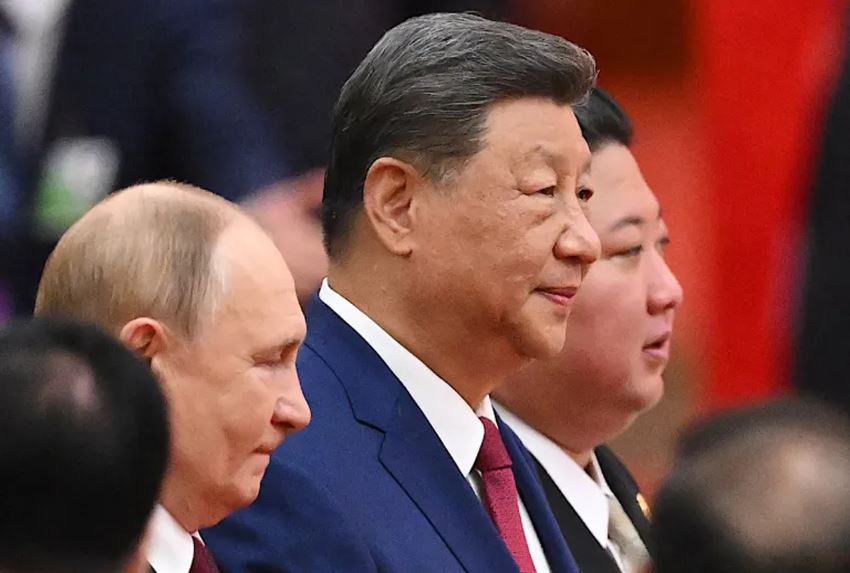
Perhaps the most symbolic image of the day was Vladimir Putin seated next to Xi Jinping. For Moscow, isolated over the Ukraine war, it offered a stage of legitimacy; for Beijing, it showcased the depth of Sino-Russian strategic trust. The timing was deliberate—while Washington hosted a trilateral dialogue with Moscow and Kyiv, Beijing and Moscow discussed the postwar order and the architecture of a new world system.
In his speech, Xi Jinping challenged the Western narrative of World War II, reminding the audience of China’s pivotal role in defeating Japan and its place as a founding player in the international order. Without escalating tensions with Tokyo, Xi emphasized historical responsibility while advocating a “community of shared destiny” in Asia-Pacific. Linking China’s past as a victim, its present as a rising power, and its future as a shaper of global order, Xi offered a holistic vision of the nation’s trajectory.
Analysts agree that the Tiananmen parade was a strategic act—blending military strength, diplomatic positioning, and historical reframing. Its dual message was clear: to the domestic audience, it boosted confidence and national pride; to the outside world, it signaled deterrence. Above all, one message stood out: “The United States is no longer the sole arbiter of global power.”
China’s Nuclear Triad: A New Pillar of Deterrence
The most striking strategic signal was the unveiling of China’s complete nuclear triad—land, sea, and air-based nuclear strike capabilities. This firmly placed Beijing among the world’s top nuclear powers.
- Land-based deterrence: The new Dongfeng-61 ICBM, with multiple warhead capability and road-mobile launch platforms for greater survivability, made its debut alongside an upgraded Dongfeng-31, a long-standing pillar of China’s nuclear forces.
- Sea-based deterrence: The Julang-3 submarine-launched ballistic missile (SLBM) gave China second-strike capability from the depths of the ocean, strengthening its nuclear survivability.
- Air-based deterrence: The long-range Jingli-1 air-launched missile, designed for China’s strategic bombers, completed the triad with the ability to hit distant infrastructure from beyond enemy defenses.
Beijing also showcased the Dongfeng-5C ICBM, with a range exceeding 20,000 kilometers and the ability to carry up to 12 warheads—effectively capable of targeting anywhere on Earth. For China, these systems represent both a shield of deterrence and a symbol of sovereignty.
Supersonic “Carrier Killers” and Naval Strategy
Beyond nuclear forces, China highlighted its arsenal of hypersonic anti-ship missiles. The Yingji family, most notably the Yingji-15 and the much-feared Yingji-21 “carrier killer”, headlined the show.
The Yingji-21, with a range of 1,500 km and speeds exceeding Mach 10 in terminal phase, is specifically designed to neutralize U.S. aircraft carriers—the cornerstone of American naval dominance. Equipped with maneuverable reentry vehicles and advanced navigation, it offers precision against large moving warships. Air-launched and ship-based variants give China unprecedented flexibility to project power across the Pacific.
A Storm of Missiles, Lasers, and Electronic Warfare
China also revealed a suite of advanced defensive systems:
- HQ-29 anti-ballistic missile system, capable of intercepting targets in near space, including low-orbit satellites.
- High-energy laser weapons, offering low-cost, rapid defense against drones.
- Microwave-based electronic warfare systems, designed to disrupt drone swarms by frying their control systems.
Together, Chinese media dubbed them the “iron anti-drone triad,” creating a layered shield against one of the fastest-growing threats in modern warfare.
Smart War: Drones, Submarines, and Robot Dogs
China showcased its vision of “intelligent warfare” with unmanned platforms:
- The HSU-100 autonomous submarine, capable of reconnaissance and undersea attacks.
- The AJX-002 submarine drone, designed to lay naval mines and potentially blockade Taiwan or critical sea lanes.
- Hybrid drones able to operate both underwater and in the air.
- Robotic quadrupeds—nicknamed “iron dogs”—mounted on armored vehicles for reconnaissance and support roles.
These systems reflect China’s focus on integrating AI and automation into future combat.
Carrier-Based Aviation: Rising Air-Sea Power
A key highlight was the new generation of carrier-based fighters:
- The J-15T, capable of both ski-jump and catapult launches, enabling operations from older and modern carriers alike.
- The J-15DT electronic warfare variant, designed to blind enemy radars and communications.
- And most importantly, the J-35 stealth fighter, a radar-evading, multi-role jet seen as the backbone of future air-sea battles.
Analysts describe the J-35 as “the key piece in China’s transition from near-sea defense to far-sea power projection.”
The “A2/AD” Doctrine: Redrawing the Map of Power
At the core of Beijing’s strategy lies the Anti-Access/Area Denial (A2/AD) doctrine—designed to deter any hostile navy from approaching Chinese waters. Long-range DF-26 missiles capable of striking Guam, hypersonic YJ-21 anti-ship weapons, and autonomous undersea drones form an interwoven net of deterrence.
The goal: make U.S. carriers and large warships face a dense web of threats too complex to overcome, effectively reshaping the Pacific balance of power.
Lessons from Ukraine and Beyond
The parade also reflected lessons learned from the Ukraine war—chiefly, the growing centrality of drones. China’s anti-drone “iron triad” was presented as a cost-effective solution to protect forces against swarms of UAVs and enemy missiles.
A Giant in the Bottle
Despite the spectacle, questions remain. Many of the weapons showcased are untested in real combat, raising doubts about scale, reliability, and integration. The parade presented an idealized image of joint command across land, sea, air, and cyber forces, but in practice China still struggles with bureaucracy, command-and-control challenges, and a lack of recent combat experience.
Logistical issues also loom: sustaining vast drone fleets, autonomous subs, and missile stockpiles requires immense infrastructure not visible on parade day. Meanwhile, every show of strength provokes counter-moves—from expanded U.S. presence in Asia to Japan’s rising military budget—fueling the risk of a new arms race.
Two Faces of One Parade
Ultimately, the 2025 parade conveyed a dual message. To domestic audiences, it was a celebration of history and a declaration of strength. To the world, it was a warning that the Pacific is no longer an American lake. Yet between declared capability and battlefield-tested reality lies uncertainty—a giant still trapped in its bottle, waiting for the moment of true test to reveal its actual weight in history.