

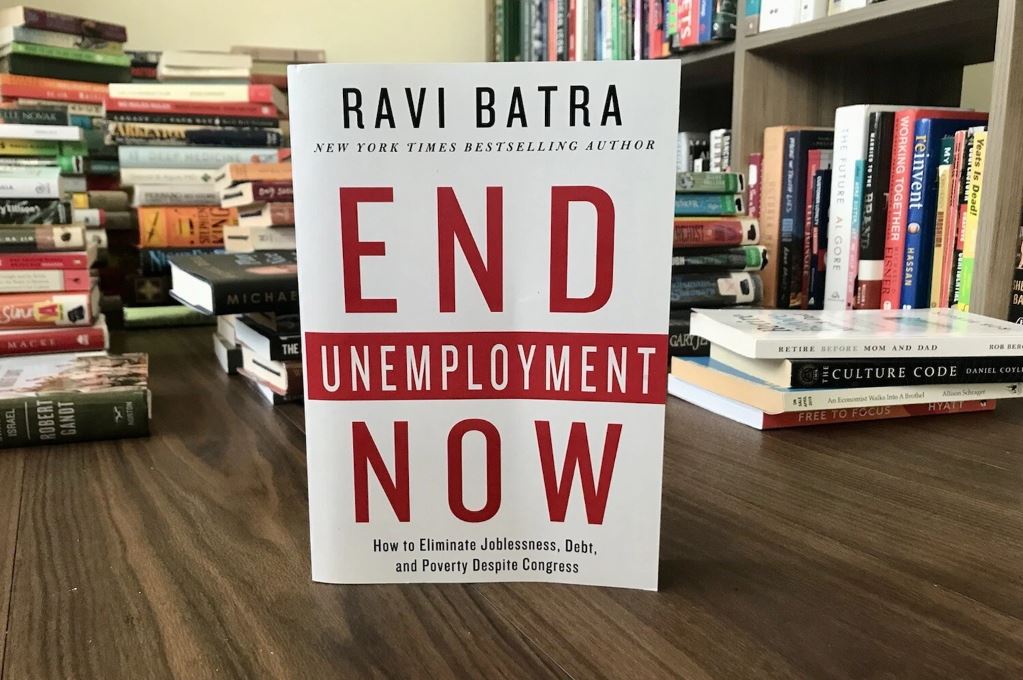
Introduction to the Book and Author
Ravi Batra, an Indian-American economist and professor at Southern Methodist University, is a prominent voice in critiquing contemporary economic structures. Known for bestselling works such as The Great Depression of 1990 and Greenspan’s Fraud, Batra reaches the peak of his ethical-economic vision in End Unemployment Now: How to Eliminate Joblessness, Debt, and Poverty Despite Congress, published in 2015 by St. Martin’s Press.
This 256-page book, written in a clear and analytical style, argues that unemployment can be nearly eliminated without passing new legislation in Congress—by using existing executive and monetary powers. Batra treats employment not as a market outcome but as a foundational ethical and institutional principle, and he boldly redefines the roles of government, market, and social justice.
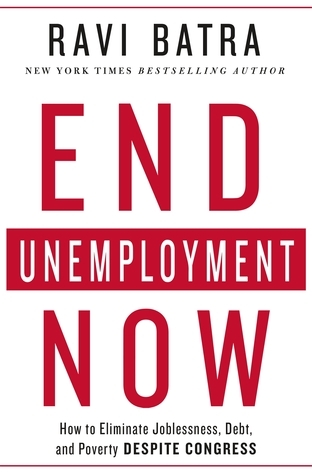
The book enters with a single claim and defends it throughout: unemployment can be eradicated within a short timeframe, without new laws—provided the executive branch and the Federal Reserve use their existing legal powers to restructure competitive dynamics. Published in 2015, the book responds to the “official end” of the Great Recession in 2010, which failed to restore jobs and deepened distributive inequalities.
Central Thesis and Intellectual Framework
Batra identifies the “ultimate source of unemployment” in monopoly capitalism: where giant corporations suppress wages, inflate prices, and extract productivity, creating surplus production that leads to layoffs and demand stagnation. The result is a vicious cycle of concentrated power and chronic unemployment. His remedy is neither unchecked government expansion nor further market liberalization, but restoring genuine competition by dismantling concentration and realigning incentives—using executive tools.
“A truly free market is impossible without dismantling monopoly power; and this task can begin through executive authority.”
Policy Tools Proposed Without Congressional Involvement
Batra lays out an “executive toolkit” aimed at boosting employment, reducing debt and poverty—while preserving market structure. The common thread is weakening monopolistic power and accelerating the engine of small businesses:
- FDIC-backed competitive bank: Establishing a bank to rival financial giants, lowering credit card interest rates to around 5% (from the typical 10–35%), thereby reducing financing costs for households and small enterprises.
- Ban on mergers between large profitable firms: Preventing consolidations that lead to layoffs and reinforce monopoly capitalism, in order to preserve competition and jobs.
- Cheap credit and government contracts for small businesses: Since the 1980s, small firms have been the real engine of employment, while large corporations often destroy jobs.
- Retirement bonds to offset falling income for seniors: As interest rates drop, retirees relying on savings suffer; this tool stabilizes their income and boosts aggregate demand.
- Pressure to reduce oil prices to around $20 per barrel: Aiming to lower living costs (e.g., gasoline at $1.50), free up disposable income, and stimulate demand.
Batra claims that implementing this package could “completely” eliminate unemployment within two years—using the existing powers of the President and the Federal Reserve, without involving Congress.
Causal Logic: From Monopoly to Unemployment, From Execution to Employment
The book’s reasoning unfolds as follows: market power concentration in finance, retail, oil, and pharmaceuticals drives prices up and wages down; surplus production and weak demand ensue; firms lay off workers; chronic unemployment, inequality, and household debt intensify. The solution, according to Batra, is to disrupt this architecture through “executive fiat”: breaking monopolies, restructuring trade, and opening space for grassroots competition and innovation. He even references post-WWII occupation models—like the breakup of Japan’s zaibatsu and Germany’s IG Farben—to show how dismantling concentration can lead to market-based recovery.
Thus, the book is both anti-monopoly and market-oriented: advocating a market without domination, not a market without government. This distinction is the intellectual backbone of the work.
Institutional Leverage: The President and Federal Reserve as Instruments
What sets this book apart is its reliance not on legislative blueprints but on existing legal powers: the President and the Federal Reserve can foster “freer market conditions” through regulatory and executive tools—from anti-merger enforcement to targeted credit policies—without waiting for partisan consensus.
This focus on execution shifts the book from a “manifesto of aspirations” to a “map of action,” while also foregrounding the political question of executive responsibility.
Intellectual Positioning: Compared with Keynes, Marx, and Institutionalism
To grasp Batra’s innovation, employment must be the axis of comparison. He treats employment not as a market byproduct but as an ethical and institutional imperative—far beyond classical Keynesianism, which saw it mainly as a tool for demand stabilization. Batra aligns with Marx in viewing labor as central to social order, but instead of critiquing value theory or abolishing ownership, he favors institutional engineering for anti-monopoly and fair competition. He also resonates with institutionalism: recognizing that rule quality (mergers, credit, energy pricing) shapes distributive outcomes, but he emphasizes the moral mission more strongly.
| Axis | Keynes | Marx | Institutionalism | Batra |
| Employment | Demand stabilizer | Core of class conflict | Function of rules | Ethical–institutional principle |
| Solution | Stimulate demand | Change ownership relations | Reform institutions | Executive anti-monopoly + fair market |
| Government | Counter-cyclical | Tool of ruling class | Rule designer | Executive disruptor & small-business ally |
Critiques, Risks, and Strengths
- Strengths: Focus on “immediate and legal” executive levers, reliance on anti-monopoly history, linking justice with efficiency, and redefining “free market” as “market without domination.” These make the book compelling for readers skeptical of official post-recession narratives.
- Execution risks: Breaking monopolies in strategic industries faces political and legal resistance; drastic oil price cuts have geopolitical and environmental consequences; competing with banking giants may trigger regulatory battles and risk displacement. The claim of “ending unemployment in two years” is ambitious and hinges on simultaneous activation of multiple levers.
- Design ambiguities: Details on rate-setting, policy sequencing, and managing unintended consequences (e.g., supply shocks) require more technical appendices; the book offers direction more than modeling.
Government in the Shadow of Capital: Batra’s View on Structural Ties Between State and Corporations
In his works, Ravi Batra portrays government not as a neutral referee in the economic arena, but as a player aligned with financial elites and monopolistic corporations. In End Unemployment Now, this view reaches its peak: the U.S. government, especially in its current structure, is not a guardian of public interest but a structural partner of monopoly capitalism.
📌 Government as an Arm of Monopoly
According to Batra, government intervention—from tax policies to bank bailouts—ultimately benefits large corporations. He repeatedly emphasizes:
“Government, through its policies, not only fails to curb monopoly—it reinforces it.”
This perspective places the government alongside economic giants, not against them. In other words, government and financial institutions operate in a mutually reinforcing cycle: regulations and policies restrict competition; corporations, through lobbying and campaign financing, steer government in their favor.
🔍 Critique of Misguided Intervention
Batra doesn’t oppose government intervention per se, but criticizes its direction—serving entrenched interests rather than public welfare. He argues that instead of supporting small businesses and job creation, government policies often empower large firms and perpetuate unemployment.
He proposes that the President and Federal Reserve, without relying on Congress, use their legal authority to dismantle monopolies and restructure competition. This separates executive action from legislative inertia—and reflects Batra’s belief in “popular intervention,” not structural entrenchment.
⚖️ Government, Justice, and Social Memory
In Batra’s view, government should safeguard social memory—prioritizing human dignity, universal employment, and distributive justice. But in its current form, government has forgotten this role and become a custodian of monopoly interests. Hence, Batra calls not for gradual reform but for bold restructuring of power.
He sees government not as the enemy of the market, but as the enemy of real competition—because by entrenching monopoly, it empties the market of meaning. Batra believes in free markets, but only if they are liberated from monopoly and collusion with financial elites.
Conclusion: A Forgetful State, a Memoryless Economy
Throughout his works, Ravi Batra depicts the state as an institution that has lost its social memory and now serves monopolistic structures. He advocates for a return to the ethical role of government—as a protector of justice—not through legislation, but through executive action. In this vision, the state must emerge from the shadow of capital and become a guardian of human dignity.
This analysis sees government not as a referee, but as a player entangled in economic power—marking Batra’s distinct position from mainstream economists.
End Unemployment Now is a manifesto for a “market without domination”: anti-monopoly, pro–fair competition, and ethically grounded in the goal of dignified employment. Batra shows how existing executive and monetary powers can be used to recalibrate incentives, ignite grassroots employment, and push back debt and poverty. Is every component immediately feasible? No. But does it offer a clear blueprint to break the vicious cycle of monopoly-driven unemployment? Yes—and that alone makes it worth serious debate and testing.
Absolutely, Sohail! Here’s the English translation of the continuation of your text:
Ravi Batra continues to live in the United States and serves as a professor of economics at Southern Methodist University in Dallas, Texas. He has been teaching at this university since the 1970s and remains actively engaged in the fields of international economics, development theory, and critiques of capitalism.
Batra’s Current Activities:
- Teaching economics at the university
- Writing and publishing analytical books on economic crises, inequality, and alternative theories
- Promoting the theory of Progressive Utilization Theory (PROUT), inspired by the spiritual teachings of his mentor, P.R. Sarkar
- Appearing in media and radio programs to analyze current economic issues
He remains a staunch critic of financial capitalism and monopolism, believing that achieving social justice requires a fundamental rethinking of economic structures.
If you’d like, I can also find or summarize his latest books or interviews for you. Just let me know what you’re looking for—analysis, critique, or inspiration.
📘 Batra, Ravi. End Unemployment Now: How to Eliminate Joblessness, Debt, and Poverty Despite Congress, pp. 1–256. New York: St. Martin’s Press, 2015.